
Photo: Anton Uniqueton / Pexels
What are pistachios
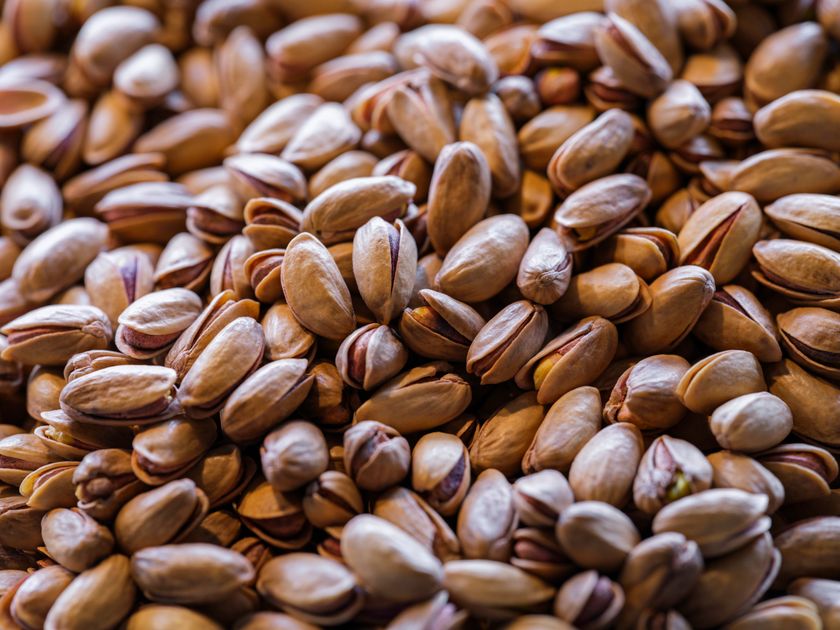
A pistachio (Pistacia vera) is a seed with a hard shell that pops open on its own once it ripens — that's the detail that separates a good batch from an unripe one. The shell sits slightly ajar. If it's fully sealed shut, it was picked too early.
Technically, what you're eating is a seed, not a nut. The tree produces a small, fleshy fruit (a drupe), and the pistachio sits inside the pit of that fruit. In the kitchen and at the store, though, it lands in the same bucket as tree nuts: almonds, cashews, walnuts.
The green color is the most recognizable trait. It comes from chlorophyll — the greener the kernel, the fresher it is and the more antioxidants it carries. Kernels that lean yellow are usually older or lower grade.
The flavor is mild, slightly sweet, and rich enough to hold its own in both dessert and savory cooking. That's why the same nut shows up in ice cream, pesto, yogurt bowls, and granola — sometimes in the same week.
Where pistachios come from
The pistachio tree originated in the Middle East — Iran, Turkey, Syria, and Afghanistan are its historic home. Today, Iran and the United States are the two biggest producers, with California growing nearly all of the US crop in the Central Valley. Turkey, Iran, and California together account for most of the world's supply.
The price stays high for reasons that have nothing to do with marketing. A pistachio tree takes 7 to 10 years before it produces commercially. Once mature, it tends to crop heavily one year and lightly the next — a natural cycle called alternate bearing that keeps annual supply uneven. Harvest is time-sensitive and labor-intensive. And Iran, historically a major exporter, has faced trade restrictions that ripple through global pricing.
None of that makes pistachios cheap, but it does explain why they cost more per ounce than almost any other nut in the bulk bin — and why the price swings more than peanuts or almonds from one year to the next.
What's inside: the nutrition
A 1-ounce serving of shelled pistachios (about 49 kernels) has roughly 160 calories, 6g of protein, 13g of fat, and 3g of fiber. For a nut, that protein number is high — it beats almonds and cashews gram for gram, and pistachios are the lowest-calorie nut per serving of the common tree nuts.
Most of that fat is unsaturated: monounsaturated (the same kind in olive oil) and polyunsaturated. That fat profile is linked to better cardiovascular markers with regular, moderate intake.
Pistachios also carry lutein and zeaxanthin, two carotenoids tied to eye health. They're one of the few plant foods with a meaningful amount of both. On top of that, pistachios are a solid source of vitamin B6, potassium, and manganese.
One honest note: pistachios are nutritious, not magic. The benefit comes from eating them regularly, in a reasonable portion, as part of a varied diet — not from one big handful making up for the rest of the week.
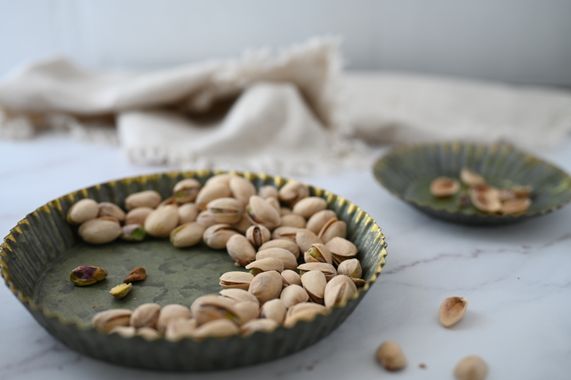
Photo: eat kubba / Pexels
Raw, roasted, shelled, salted — what's the difference
The pistachio aisle sells more variations than most nuts. Knowing what each one is for keeps you from buying the wrong bag for the recipe.
In-shell vs shelled
Most snack bags sell pistachios in the shell — the shell protects the kernel and extends shelf life. Shelled pistachios cost more per ounce but save the work of cracking each one, which matters if you're baking or topping a dish rather than snacking by hand. Nutritionally, the kernel itself is identical either way — the shell doesn't add or take away anything.
Raw vs roasted
Raw pistachios are unroasted — most "raw" pistachios sold in stores are lightly steam-pasteurized for food safety, but that step doesn't roast them, so they still count as raw. Roasted pistachios go through actual heat processing, which deepens the flavor and adds crunch. Nutritionally the two are close, though raw holds onto slightly more of its antioxidants. If you plan to toast them yourself for a recipe, buy raw and control the process.
Salted vs unsalted
Salted is the most common snack format. It's fine for eating straight from the bag, but the added sodium makes it a poor fit for sweet recipes, where salt throws off the balance. For baking, pesto, or anything where you're controlling the seasoning yourself, buy unsalted.
Paste and chopped
Pistachio paste has shown up everywhere in pastry over the past few years — croissant filling, cake batter, cream. Chopped or crushed pistachios are the go-to for finishing ice cream, cakes, and dishes like baklava. Both are usually found at specialty grocers or ordered online rather than the regular nut aisle.

Photo: SC Studio / Pexels
How to cook with pistachios
The rule of thumb: pistachios work anywhere almonds work, with a more distinct flavor. The green color also does a lot of visual work — a scattering of chopped pistachios makes almost any plate look finished.
As a snack
The simplest use, and the one that disappears fastest. A handful of in-shell pistachios is more satisfying than it sounds — cracking each one slows you down, which naturally caps how much you eat. You buy a bag for a recipe, snack through half of it before you even start cooking, and end up buying more. Everyone does this.
Breakfast
Roughly chopped pistachios work well stirred into plain yogurt with honey, or mixed into granola. They add crunch, protein, and a flavor that's a break from the usual almond-and-walnut mix.
Desserts
Ice cream, cake, brownies, mousse, baklava, biscotti. Pistachios have enough flavor to hold their own even next to something as intense as chocolate. Pistachio paste works the same way peanut butter does — in fillings, frostings, and creams.
Savory dishes
Less obvious, but one of the best uses. Pistachio pesto (swapped in for pine nuts) pairs well with pasta and chicken. Crushed pistachios make a fast, effective crust for baked fish or chicken. In Moroccan couscous and lamb dishes across the Middle East, pistachios are a traditional ingredient, not a trend.
Toasting them yourself
If you bought raw, toast before using: dry skillet, medium heat, 3 to 5 minutes, stirring the whole time. The aroma changes completely. Don't let them go past golden — burnt pistachios carry a bitterness that doesn't go away.
Cooking shouldn't be this much of a headache. Mise fixes that.
Start free →How to store pistachios so they don't go stale
Pistachios have a high fat content, which is exactly what makes them go rancid if you leave the bag open on the counter. Storage matters more with pistachios than with most pantry staples.
In the shell
The shell buys you time. Sealed in an airtight container at room temperature, in-shell pistachios hold their quality for several months — some sources say up to a year in good conditions. It's the lowest-maintenance format if you're not going through them fast.
Shelled
More exposed to air, so more prone to oxidizing. Keep shelled pistachios in a sealed jar or airtight container. If you won't finish the bag within a month, move them to the fridge — or the freezer for longer storage, where they'll keep for up to a year without losing much flavor.
Either way, the enemy is air and light, not time by itself. A properly sealed container does more for shelf life than the date on the bag.
Are pistachios worth keeping in your pantry
It depends on what you're going to do with them.
If you already snack on nuts — almonds, cashews, walnuts — pistachios are a solid rotation. Good protein-to-calorie ratio, distinct flavor, easy to fit into what you're already eating. A well-stocked pantry handles them fine: in the shell, they last for months without any special care.
If the plan is to cook with them, buy shelled and unsalted — you'll get more control and actually use what you bought. Salted, in-shell pistachios tend to get eaten as a snack before they ever make it into a recipe.
If you're buying them because they're the trendy ingredient of the moment and you don't have a clear use in mind, they'll probably end up forgotten in a jar. A new ingredient only earns a spot in your routine when it has a use attached before the purchase — different from almonds, which everyone already knows what to do with.
Pistachios aren't a pantry basic the way olive oil or garlic are — but if you cook with any variety, or already have a recipe in mind, they're worth adding to the shopping list next time the price looks fair.
Pistachios on the list. Just don't eat the whole bag before you get home.
Frequently asked questions about pistachios
Are pistachios a fruit or a nut?
Technically a seed — the tree produces a drupe with a hard pit, and the pistachio is the seed inside that pit. In cooking and at the store, it's grouped with tree nuts, since the nutrition and the way you use it in the kitchen are the same.
Do pistachios make you gain weight?
They're calorie-dense like any nut — most of the energy comes from fat, which is mostly unsaturated (the same kind in olive oil). In a reasonable portion (about 1 ounce), they're more filling and more nutritious than most packaged snacks. The problem is usually finishing the whole bag.
How many pistachios should you eat a day?
A standard serving is about 1 ounce (28g) — roughly 49 kernels, or one closed handful. That's enough to get the benefits without piling on calories. As a between-meal snack, that's a solid daily limit.
Are salted pistachios worse than raw?
They carry more sodium, which matters if you're watching blood pressure. Otherwise the nutrition is nearly the same. For recipes, unsalted gives you more control over seasoning. For snacking, salted is just a matter of taste.
How do you store pistachios so they last?
In the shell, sealed at room temperature, they last for months. Shelled, keep them in an airtight container — move to the fridge or freezer if you need more than a month of storage. Left exposed to air, they turn rancid. Never leave the bag open for long.
Are pistachios gluten-free and dairy-free?
Plain pistachios have no gluten and no dairy. Processed versions — seasoned or blended into snack mixes — can pick up cross-contamination with gluten depending on the facility. Pistachio paste and pistachio ice cream usually contain dairy if made with milk. Always check the label.
Know what's in the pantry.
Let Mise handle the rest.
Mise connects your pantry, recipes, and shopping list in one place. You buy what you'll actually use — and the pistachios don't disappear before they become dinner.